
Appearance
Use Cases
Quisim fits a wide range of simulation work — from your first queueing model to full production systems. Here are some of the areas where it is used.
Operations Research
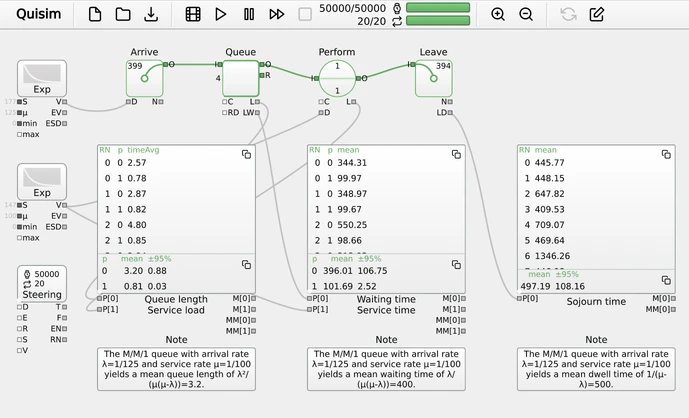
Build queueing models, scheduling problems, and optimization studies in minutes. Quisim supports classic M/M/1 and M/M/k queues, priority disciplines, and network topologies — letting you develop intuition for system behavior before reaching for the math.
Experiment with arrival rates, service distributions, and number of servers to see how each parameter changes waiting times, utilization, and throughput.
Service Operations
Model call centers, retail stores, banks, restaurants, and government offices. Simulate staffing levels, queue policies, and routing rules to find the right balance between service quality and operating cost. Compare scenarios side by side — adding a server during peak hours, splitting one queue into two, prioritizing certain customer types — and see how each choice changes wait times and throughput.
Healthcare Systems
Model patient flow through emergency departments, outpatient clinics, and hospital wards. Simulate triage, bed allocation, staffing decisions, and discharge processes to understand the dynamics that drive wait times and resource bottlenecks.
Live charts show bed occupancy, length-of-stay, and wait time distributions as the simulation runs, turning abstract dynamics into something you can watch unfold.
Manufacturing & Supply Chains
Simulate production lines, inventory systems, and logistics networks. Model workstations, buffers, conveyors, and reorder policies to explore trade-offs between throughput, inventory cost, and service levels.
The example below shows a cross-docking model: incoming trucks are unloaded at three inbound ramps, and pallets are either stored or loaded directly onto outgoing trucks at two outbound ramps — letting you study the trade-off between buffer space and truck synchronization.